


Your teams have better things to do than retype faxes
Healthcare information still arrives through disconnected channels: e-faxes, scanned PDFs, handwritten orders, referral forms, insurance cards, and clinical documents.
Someone has to open each file, identify what it is, find the relevant information, and enter that information into the correct system. When volumes rise, the backlog grows. Errors follow. Scheduling, authorizations, billing, and patient care can all slow down.
Document Capture Plus takes that repetitive work off your staff’s plate while keeping review and control where they matter.
From incoming document to usable data
1. Documents are received and sorted
Document Capture Plus processes incoming healthcare documents from your existing intake channels, classifies the document type and routes it to the right person or AI agent depending on the business rules you have set up.
2. The right information is captured
AI agents split multi-document packets and extract configured fields such as patient demographics, insurance details, order information, diagnosis codes, procedure codes, and authorization data.
3. Data is checked before it moves forward
Validation rules flag missing, inconsistent, or low-confidence information before it reaches your system of record.
4. Clean data goes where your teams need it
The information is routed to the appropriate patient record and workflow, reducing manual copy-and-paste work across patient access and revenue cycle operations
Performance at a glance
70–75%
Straight-through processing
7–10s
Processing time per page
85%
Less manual intervention
500+
Faxes processed per hour
Automation handles the routine work. Specialists handle the exceptions
Most document workflows contain a mix of clean, predictable files and difficult edge cases. Document Capture Plus treats them differently.
Built for real healthcare document workflows
Document Capture Plus transforms incoming healthcare documents into structured, usable data, eliminating manual entry and enabling faster, more accurate patient access and revenue cycle operations.
Protect the patient record
Configured validation checks help prevent incomplete or inaccurate information from entering your EHR or practice management system.
Work across systems
Document Capture Plus can support workflow-specific integrations and data-entry processes using methods such as APIs, HL7, SFTP, and RPA, depending on the customer environment.
Stay in control
Quality checks, exception routing, audit trails, and performance monitoring give teams visibility into what moved automatically, what required review, and what still needs attention.
Improve over time: Every exception reveals something useful. Recurring issues can become new routing rules, validation checks, or review criteria. Over time, your workflow becomes more consistent and requires less manual intervention.
The platform
Runs on the Infinx Healthcare Revenue OS
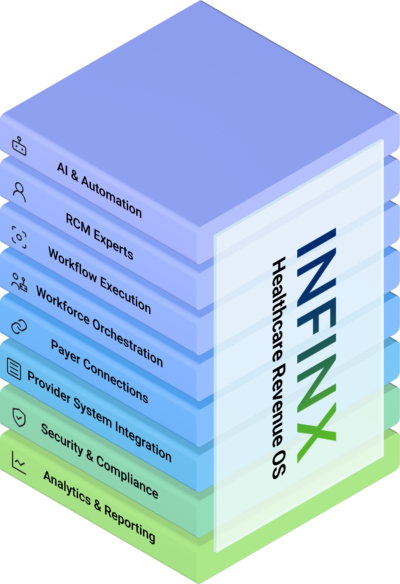
Document Capture Plus works within the Infinx Healthcare Revenue OS, which coordinates AI agents, workflow automation, system integrations, analytics, and human specialists across healthcare revenue workflows.
The broader operating model provides the controls needed to scale document automation across teams, locations, and document types.
Start with one high-impact document workflow
Choose a document-heavy workflow where manual work, delays, or data-entry errors are creating the most friction.
Infinx will help map the current process, define which work can move automatically, identify where specialist review belongs, and agree on the measures used to evaluate impact during the first 60–90 days.